ECHOES OF MEMORY
FELLOWSHIPS
A Real Start
Experience Museo | Season 2026–27 | Applications open now, closing September 7, 2026, at 12 pm CDT
Training makes you technically good and leaves you to work out what makes you you.
We know you have been left in the dark about how to show who you are.
The Echoes of Memory Fellowship pays you, gives you two mentors, one in music and one in cultural work, and a season where you shape work of your own and show it, alongside artists, clinicians and the people who come, inside a community of practice that stays after the season closes.
You leave with work that could only be yours, hours you can show, and people who keep working with you.
We are choosing four fellows in Houston: three musicians and one digital storyteller. Every place is paid, and applying is free.
Apply as a musician
Apply as a digital storyteller
THE WORLD YOU WOULD BE JOINING
Echoes of Memory. The season. It runs September to May, and it is about what music, story, and presence do for the way we remember, and what they give people who are carrying something. Four themes run through it, in this order: connection, belonging, memory, hope. The season connects, then belongs, then remembers together, and hope is what remembering together gives back.
Healing through the arts. The field we work in. It has a name—arts in health—and decades of research behind it. At Experience Museo, we are exploring what healing through the arts means, together with the artists, fellows, and communities we work with. This season that work sits with the fellows and the artists in residence. Later seasons open it to the practices in the building, each in their own field.
Experience Museo. The people behind these fellowships. Experience Museo is the cultural life of Museo, a medical building in Houston’s Museum District. Concerts, workshops, movement, art, and conversation. The building is devoted to healing. The season is open to anyone in the city. A place to belong.
Museo. The building where it all happens. Museo is a medical building in Houston’s Museum District, built on the belief that where you are cared for is part of the care. A place to heal.
THE SEASON AND WHAT WE MEAN BY IT
This is living art. We make our season during the year. Elsewhere a season is announced complete, and you choose which events to attend. We spend ours making art, researching together, telling stories, and asking questions, and we invite you in as it grows.
Everything runs in parallel. Workshops, talks, research, and rehearsal run alongside each other all year, and each concert shows what the season has made so far.
The season runs September to May. It opens with a concert on September 12, moves through salons, workshops, and gatherings across the year, and closes with Echoes of Memory: A Festival of Voices on May 1. Fellows begin working in October and stay through to the end. The people in it are what make it: three young musicians, three artists in residence, one storyteller-in-training alongside our chief storyteller, and the audiences who keep coming back. That is what we mean by a community of practice, and it does not break up when the season closes.
This is our first season, and what you make in it becomes part of the answer.
WHERE THIS COMES FROM
At Epidaurus, the Greek healing sanctuary held a hospital, baths, a library, sports grounds, and one of the great theaters of the Greek world, all inside one site. UNESCO calls it the earliest organized sanatorium and lists the theater among the sanctuary’s functions. Asclepius, the god of medicine, was the son of Apollo, who held both music and healing.
Care and culture shared an address for centuries. Somewhere after that we separated them. Experience Museo puts them back in one building, on the belief that being among other people is part of how anyone heals.
That belief is the thing we are asking you to work on with us. It is not settled. We are looking for fellows who will argue with it.
WHICH TRACK IS YOURS
One fellowship, two tracks, which run alongside each other. The fellows in them work together.
Musician track
- Three fellows, high-school age and up, about fifteen years and older
- Any instrument, any voice
- You perform twice, we record you, and the recordings are yours
- About two hours a week, plus rehearsals before each performance
Digital storyteller track
- One fellow, eighteen or older
- Any storytelling background: film, video, writing, spoken word, photography, audio
- You learn the craft, train as a facilitator, and lead paid community workshops
- Training blocks across the season, plus presence at everything we make
Read the tab for the track that is yours. If both speak to you, apply to the one you would give the year to.
TRUE OF BOTH
Applying is free. Always. If money, distance, or anything else is standing in your way, tell us. We will help you find a way in.
You should live in the Houston area. Most of the season runs online. Museo hosts the in-person sessions and performances, in the Museum District, so you take part both ways throughout the year.
Both tracks are paid, and both are chosen in September, musicians by audition and the storyteller by interview. Both give you two mentors, one in your own art form and one in cultural work, and a written record of your hours, the settings you worked in, and the people you worked with. In this field, that record is the credential, and almost no program of our size provides one.
WHO YOU WOULD WORK WITH
Three artists in residence carry the season: Eleni Calenos, Greek soprano; Teruhiko Toda, Japanese pianist and conductor; and Benjamín Serur, Venezuelan cellist.
Horten Barrios-Gómez created Experience Museo and leads the storytelling work. Raina Schnider coordinates the program.
Applications close September 7, 2026, at 12 pm CDT.
Apply as a musician
Apply as a digital storyteller
Questions? Write to us at info@experiencemuseo.com.
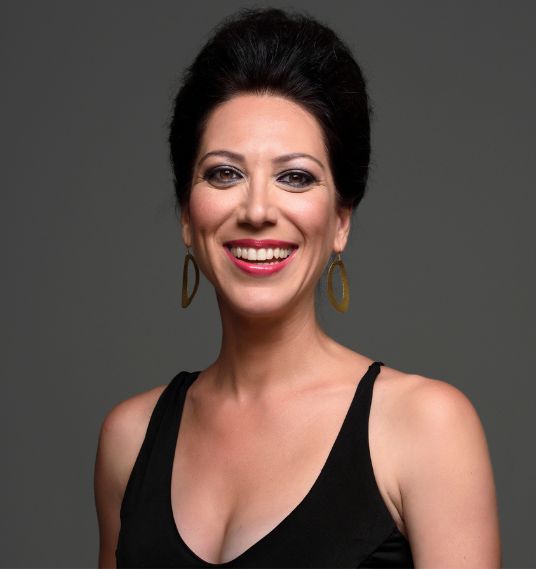
Eleni Calenos
Soprano
Greek soprano Eleni Calenos has earned the admiration of critics and audiences for the clarity, warmth, and beauty of her voice, and for the quiet dignity of her characterizations. Of her Tosca, Opera News wrote that she “gave a performance for the ages, both vocally and dramatically,” and The Wall Street Journal called it “searing... passionate, mercurial, heart-on-the-sleeve, with all the necessary vocal range, stamina and fire.” Reviewing her Cio-Cio-San, the Houston Press found “a true wonder to hear.”
Her repertoire spans more than thirty operatic roles, among them Mimì in La Bohème, Cio-Cio-San in Madama Butterfly, the title roles in Suor Angelica and Tosca, Santuzza in Cavalleria Rusticana, Liù in Turandot, Giorgetta in Il Tabarro, Nedda in I Pagliacci, Desdemona in Otello, the Countess in Le Nozze di Figaro, and Donna Anna and Donna Elvira in Don Giovanni.
She has also given voice to new work, creating Saida in the world premiere of Eichberg’s Schönerland and roles in the premieres of George Hatzinasios’s El Greco and Nikolaos Metaxas-Tzanis’s Marco Bozzari. On the concert stage, she has sung Verdi’s “Requiem,” Brahms’s “Ein Deutsches Requiem,” Beethoven’s Ninth Symphony and “Missa Solemnis,” Mahler’s Second Symphony, Handel’s “Theodora,” Barber’s “Knoxville: Summer of 1915,” and Rutter’s “Magnificat” at Lincoln Center.
She has appeared with the Greek National Opera, Opera Santa Barbara, Shreveport Opera, Maryland Lyric Opera, Opera Orlando, and Cleveland Opera Theater, among many others, and made her German debut at the Wiesbaden Staatstheater. Her recordings include Mascagni’s Zanetto with Odyssey Opera, two of Samaras’s operettas with the Greek National Opera, and Tsontakis’s Mirologhia on KOCH International Classics.
Her ties to Houston run deep. She made her US debut as Cio-Cio-San with Opera in the Heights, and in 2025 returned for a recital at Museo, the same setting that hosts this evening’s concert. Born in Thessaloniki, she holds a diploma in cello from her city’s Municipal Conservatory, a voice diploma from the National Conservatory of Athens, a master’s degree from Queens College, City University of New York, and a performance certificate from the Opera Institute of Boston University.
In recital, her approach is intimate and focused. She brings a sensitivity to language and phrasing that keeps the music close, creating space for reflection and connection within the audience. It is this quality—presence more than display—that she carries into Echoes of Memory
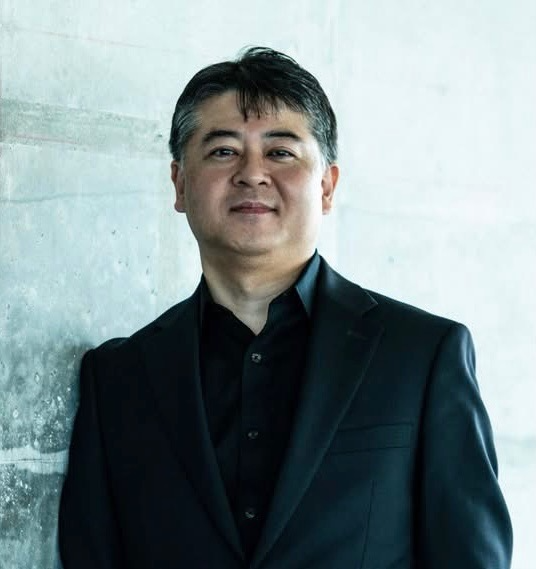
Teruhiko Toda
Pianist & Conductor
Houston-based pianist and conductor Teruhiko Toda has spent his career close to the singing voice: at the keyboard, in the coaching studio, and on the podium. He currently serves as staff accompanist at the University of Houston and at Lone Star College-Kingwood, and for several years was music director of Houston Grand Opera’s touring outreach program, Opera to Go!, which he led to wide success.
His work as a conductor and repetiteur spans two continents. With Opera in the Heights, he served as assistant conductor and head repetiteur for productions including Macbeth, Otello, La Traviata, Un Ballo in Maschera, Don Carlo, Anna Bolena, and Manon. In Tokyo, he was assistant conductor and repetiteur at the New National Theatre, preparing productions such as Wagner’s Götterdämmerung, Die Meistersinger, and Tannhäuser, alongside Madama Butterfly and Così Fan Tutte, and he conducted L’Elisir d’Amore in 2007. His broader engagements include the RAI Torino Symphony Orchestra, the Yomiuri Nippon Symphony, the Tokyo Metropolitan Symphony, and the Nikikai Opera Foundation, with an operatic repertoire of more than sixty complete works.
Trained at the Tokyo College of Music, where he earned a bachelor’s degree in piano performance and a graduate diploma in accompaniment, he returned there as an associate professor and coached opera students for a decade. He began his performing life as a soloist, giving a recital in Italy in 1996.
Over the years, he has partnered with many distinguished singers, among them Denyce Graves, Ryan McKinny, Kurt Moll, Stephen Gould, and the Metropolitan Opera soprano Michelle Bradley, and has worked under conductors including Herbert Blomstedt, Gerd Albrecht, Dan Ettinger, and Philippe Auguin. He has performed for President George H. W. Bush, and in 2015 his article on Houston Grand Opera’s outreach program appeared in the Japanese classical music magazine Ongaku no Tomo.
For Echoes of Memory, he brings the sensitivity of a lifelong listener, pianist, and conductor who makes room for the voice and for silence.
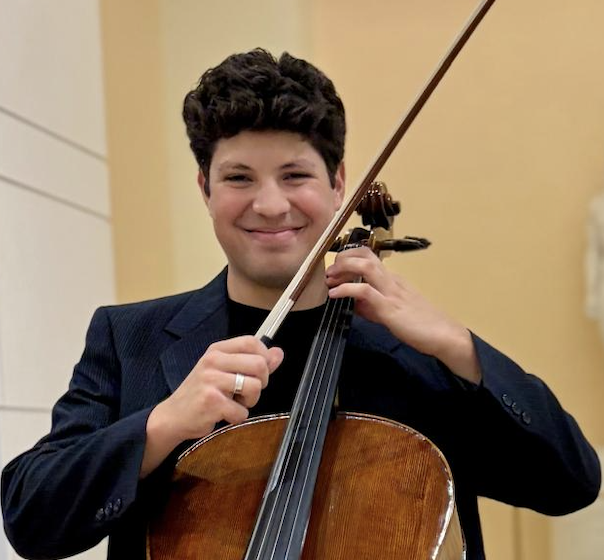
Benjamín Serur
Cellist
Venezuelan cellist Benjamín Serur began his musical life at the age of five through El Sistema, Venezuela’s celebrated National System of Youth and Children’s Orchestras and Choirs. That tradition’s warmth and sense of ensemble still shape the attentive, generous, and grounded way he plays.
In 2016, he entered the Simón Bolívar Music Conservatory in Caracas, working with Maestros Francy Vásquez and Juan J. Romero, and the following year joined the Chacao Youth Symphony Orchestra under Maestro Ulyses Ascanio. In April 2018, he immigrated to the United States, where Courtenay Vandiver Pereira mentored him through his high school years.
Benjamín holds a bachelor’s degree in cello performance from the Moores School of Music at the University of Houston, where he studied with Dr. Eunghee Cho, and is now pursuing a master’s degree at the Shepherd School of Music at Rice University under Valentin Radutiu. He has held principal positions with the Moores School Symphony Orchestra, Opera Orchestra, and Cello Ensemble, as well as the Houston Youth Symphony and Virtuosi of Houston, with whom he performed at the Kennedy Center. He was a member of Carnegie Hall’s National Youth Orchestra (NYO2) and a prize-winner in the Virtuosi of Houston concerto competition.
His festival appearances include the Maine Chamber Music Seminar, the Emerald Coast Chamber Music Festival, the International Cello Institute, the Texas Music Festival, and House of Cello, and he has studied in master classes with cellists such as Paul Katz, Desmond Hoebig, Brannon Cho, and Rhonda Rider. He performs widely across Houston, on stages including Zilkha Hall, Saengerhalle, and the Brown Theater.
To Echoes of Memory, he brings a young artist’s openness and a deep feeling for the cello’s singing, human voice.